
A break-in happens at 2 AM. Your CCTV records every second of it. The problem is, nobody actually sees it happen until someone opens up the footage on Monday morning. By then, the cash is gone, the tools are gone, and all that is left is video proof of a loss nobody could stop.
This is the gap that traditional CCTV has always had. It documents what happened. It does not stop what is happening.
This is the gap that remote video monitoring Canada services were built to close. Instead of a camera that only records, a live monitoring system watches your property in real time, uses AI to flag genuine threats, and gets a trained agent to step in immediately, often before any loss happens at all.
This guide breaks down exactly how remote video monitoring works, how it differs from standard CCTV, and who it makes sense for if you run a business in Moncton, Saint John, Fredericton, or anywhere else in New Brunswick.
Quick Answer
Remote video monitoring combines AI-powered cameras, live security agents, and predefined response procedures to provide real-time security oversight. By detecting and responding to suspicious activity as it occurs, businesses can better protect their property from theft, vandalism, and unauthorized access instead of relying solely on recorded footage after an incident. The main benefits are 24/7 coverage, faster response times, lower costs than full-time guards, verified alarms, and the ability to manage multiple properties remotely.
What Is Remote Video Monitoring?
Remote video monitoring is a security service where cameras at your property are actively watched by trained professionals who can verify a threat and respond to it in real time, rather than just recording footage for someone to review later.
That is the whole idea in one sentence. The real shift is moving from passive recording to active watching.
With ordinary CCTV, a camera records continuously or on motion, and the footage sits in storage. Nobody is watching live. If something happens overnight, you find out whenever someone gets around to checking the system, which could be hours or even days later.
A live video monitoring service works differently. The cameras feed into a monitoring centre where software and trained people are paying attention around the clock. When something suspicious happens, like a person climbing a fence or a vehicle idling near a loading dock at 3 AM, the system flags it right away and a real agent looks at the footage within seconds.
This kind of setup is also called a remote surveillance system, because the monitoring happens off-site rather than from a guard sitting in a booth on your property.
How Does Remote Video Monitoring Work?
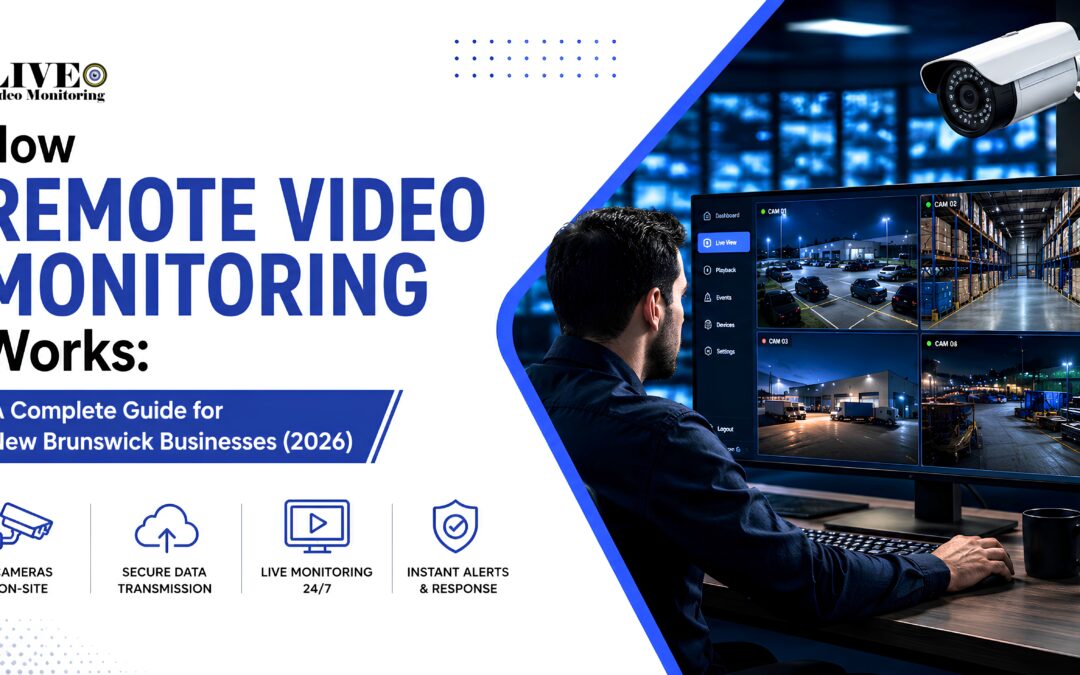
Remote video monitoring works by combining AI-powered cameras, software analytics, and live security agents who verify threats and respond in real time. The process unfolds in five steps, from the moment a camera detects movement to the moment a situation is resolved.
Step 1: Cameras Capture Activity
The process begins with the cameras installed across the property. Most remote video monitoring systems use high-definition IP cameras that capture clear footage day and night, providing reliable visibility across key areas. For larger environments such as construction sites, warehouses, and industrial facilities, thermal cameras may also be used. Unlike standard cameras that rely on visible light, thermal cameras detect heat signatures, allowing them to identify people and vehicles in complete darkness, heavy fog, or adverse weather conditions—an important advantage for businesses operating in the Maritimes.
Step 2: AI Filters Out False Alarms
Not every bit of motion matters. A blowing tarp, a passing raccoon, or a shadow moving across a parking lot can all trigger a basic motion sensor. AI analytics software reviews every motion event before a human ever sees it, and it is specifically trained to tell the difference between an animal, weather, a shadow, and an actual person or vehicle. AI motion filtering can eliminate up to 95 percent of nuisance alerts, the kind that used to waste hours of a security guard's shift checking on nothing.
This problem is not new. Traditional alarm systems that rely only on basic motion sensors have struggled with false triggers for decades. Studies on conventional burglar alarms have repeatedly found that the vast majority of police callouts, often more than 90 percent, turn out to be false alarms rather than real break-ins. AI filtering is largely a response to that long-standing problem.
Step 3: Human Agents Verify Threats
When the AI flags something worth a closer look, the alert lands with a real person at a Security Operations Centre, often shortened to SOC. The agent reviews the live feed along with a short clip recorded just before the alert triggered, known as pre-event footage, to confirm whether it is an actual threat or just another false positive that slipped through.
Step 4: Immediate Intervention
If the agent confirms a genuine threat, they can speak directly through the camera's built-in speaker using two-way audio. A typical warning might sound something like, “You in the red jacket, please leave the property immediately.” Hearing a live human voice catches most intruders off guard, and in a lot of cases that alone is enough to make them leave before anything is taken or damaged.
Step 5: Escalation and Response
If the person does not leave, the agent escalates the situation. Depending on what is set up for your site, that can mean calling local police, dispatching a mobile guard, or notifying you directly, with timestamped video already attached as evidence. Every incident gets logged, so there is a clear record if you ever need it for a claim or a follow-up investigation.
A Real-World Example
Picture a construction company working on a project just outside Saint John. A gate is accidentally left unlocked on a Friday afternoon, and by 1 AM someone has climbed the fence. With remote video monitoring in place, an agent gets an alert within seconds, checks the footage, and issues a live voice warning through the camera speaker. The person leaves before any tools or materials are touched. Without monitoring, the same site owner might not have found out about the break-in until Monday morning, by which point the equipment would already be gone.
Remote Video Monitoring vs Traditional CCTV
Traditional CCTV documents incidents after they have already happened. Remote video monitoring is built to help prevent them in the first place. Here is how the two compare side by side.
| Feature | Traditional CCTV | Remote Video Monitoring |
|---|---|---|
| Live monitoring | No, footage is only reviewed after the fact | Yes, watched in real time |
| Real-time response | Not possible | Agents respond as events happen |
| AI filtering | Rarely included | Filters out false alarms automatically |
| Voice intervention | Not available | Live two-way audio warnings |
| Police dispatch | Only after footage is reviewed later | Immediate, with verified video evidence |
| Incident prevention | Documents losses after they occur | Aims to stop incidents in progress |
Core Technologies Behind Modern Remote Video Monitoring
Edge AI Analytics
Edge AI means the analysis happens right on or near the camera itself, instead of waiting for footage to travel to a distant server first. That shortens the time between something happening and an alert reaching an agent, which matters when every second counts.
Cloud-Based Video Management Systems
Footage and live feeds are usually organized through a video management system, or VMS. Platforms such as Genetec and Avigilon, now part of Motorola Solutions, are common examples in the Canadian market, letting a monitoring centre view multiple cameras across multiple sites from a single dashboard.
Thermal Imaging
Thermal cameras detect heat rather than light, so they keep working in total darkness, fog, or heavy snow, conditions that are not exactly rare during a New Brunswick winter.
Mobile Surveillance Units
For sites without permanent power or wiring, solar-powered camera trailers with 5G connectivity can be set up in a matter of hours. These mobile units are common on construction sites and remote industrial locations where running cables simply is not practical.
Who Can Benefit from Remote Video Monitoring?
Retail Businesses
Retail businesses are often vulnerable to after-hours break-ins, particularly when premises remain unoccupied overnight. Smaller stores, shopping plazas, and high-street retail locations can be attractive targets for theft and vandalism outside trading hours, making proactive security measures an important consideration for business owners.
Warehouses and Logistics Facilities
Cargo theft is an ongoing concern for warehouses and distribution centres, where high-value goods can sit on loading docks for hours before they are moved. Trailer theft across Canada nearly doubled in 2025 compared with the year before, according to data from the Equité Association, and parked or unattended trailers are the most common target.
Construction Sites
Equipment theft and vandalism cost the construction industry an estimated $46 million a year in Canada, and most sites sit completely unattended overnight, on weekends, and over holidays, whether that is a subdivision going up outside Fredericton or a commercial building in Miramichi.
Industrial Facilities
Industrial sites, including those around Edmundston and the Saint John industrial corridor, often cover large areas with valuable equipment and materials, including copper wiring, that are difficult to protect with on-site guards alone.
Parking Lots
Vehicle crime and trespassing are common in parking lots, particularly ones attached to retail centres or apartment buildings in busier areas like Fredericton or Moncton that see little foot traffic after hours.
Residential Communities
Housing developments and community properties dealing with vehicle crime in shared parking areas, or unauthorized access, are increasingly turning to video monitoring for business-grade common areas, where one system can cover several buildings or entry points at once.
Key Benefits of Remote Video Monitoring
- 24/7 protection: 24/7 CCTV monitoring means your property is watched every hour of every day, including weekends and holidays.
- Faster response times: agents step in within seconds rather than someone noticing the footage hours or days later.
- Lower cost than guards: monitoring multiple cameras from one centre is typically far less expensive than paying for round-the-clock on-site guards.
- Reduced theft and loss: live intervention often stops an incident before anything is taken or damaged.
- Scalability: adding cameras or new sites does not require hiring more on-site staff.
- Better incident documentation: every event is timestamped, recorded, and logged with agent notes.
- Insurance support: verified, documented incident reports can help support a claim.
- Remote management: business owners and managers can check in on a property from anywhere.
Is Remote Video Monitoring Worth It?
For most businesses that need after-hours security, remote video monitoring is worth it because it provides a real-time human response at a lower ongoing cost than full-time on-site guards, while also creating a documented record of every incident.
Is Remote Video Monitoring More Cost-Effective Than Security Guards?
For many businesses, particularly those requiring after-hours security, managing multiple locations, or protecting large properties with several access points, remote video monitoring can offer a more cost-effective approach than traditional on-site guarding. While costs vary based on site requirements and coverage levels, the overall investment is often lower when compared with maintaining continuous physical security coverage.
- Guard costs: national wage data puts average security guard pay in Canada at roughly $17 to $20 an hour. Covering one site around the clock means multiple shifts a day, seven days a week, and that adds up quickly once payroll, supervision, and benefits are included. Covering several locations with on-site guards multiplies the cost again.
- Multi-site monitoring savings: a remote monitoring centre can watch cameras across several properties at the same time, so the cost of coverage is shared across many cameras instead of tying one guard to one site.
- Theft prevention: because agents step in immediately instead of only documenting an incident afterward, businesses often see fewer completed thefts, which reduces the ongoing cost of replacing stolen equipment and repairing damage.
- Insurance benefits: documented, verified monitoring can support an insurance claim, and some insurers factor active monitoring into how they assess risk and set premiums.
Privacy and Compliance Considerations in Canada
PIPEDA Overview
The federal Personal Information Protection and Electronic Documents Act, or PIPEDA, governs how private businesses collect, use, and store personal information, including video of identifiable people. Guidance published by the Office of the Privacy Commissioner of Canada sets out what businesses need to do to stay compliant. New Brunswick public bodies follow a separate provincial law, RTIPPA, but private businesses, such as most retailers, warehouses, and construction companies, fall under PIPEDA.
Signage Requirements
Businesses should post clear signs at entrances and around the property letting visitors know the area is under video surveillance, why it is there, and who to contact with questions.
Data Retention
Footage should only be kept for as long as it is actually needed. Once an incident is resolved and any chance of a claim has passed, recordings should be deleted on a set schedule rather than stored indefinitely.
Privacy Officer Responsibilities
Every business using video surveillance should have someone responsible for overseeing how footage is collected, stored, and shared, and for handling any privacy questions that come up.
Why Businesses Are Choosing Live Eye Video Monitoring
AI + Human Verification Model
Live Eye Video Monitoring, operating as Eagle Eye One Solutions, combines AI detection with trained human agents, so alerts are filtered automatically while every real threat still gets a human decision before any action is taken.
24/7 Monitoring Operations
Their monitoring centre runs around the clock, every day of the year, so coverage does not stop on weekends or holidays, which is often exactly when incidents happen.
Industry Experience
Live Eye Video Monitoring works across commercial and industrial properties, cargo and logistics operations, parking facilities, residential and community developments, and specialized environments such as casinos, where security needs are especially demanding.
How the Process Works
Their approach generally follows four stages: a consultation to assess the specific risks at a site, system integration to configure the right cameras and technology, active monitoring by trained agents, and an immediate response whenever a threat is confirmed.
Frequently Asked Questions
Remote video monitoring is a security service where cameras installed at your premises are actively watched in real time by trained professionals at an off-site monitoring centre. Because someone is always watching, agents can take immediate action the moment a genuine threat is detected, rather than simply recording footage for someone to review after the fact.
Traditional CCTV records footage so it can be reviewed after an incident has already happened. Remote video monitoring involves live agents who watch verified alerts as they occur and respond immediately, using voice warnings or escalation, instead of only documenting a loss after it has already taken place.
Costs vary depending on the number of cameras, the hours of coverage needed, and how complex the site is. For businesses needing multi-camera or after-hours coverage, remote monitoring is typically more cost-effective than paying for an equivalent amount of on-site guard hours.
In many cases, yes. Compatible IP cameras can often be integrated into a live monitoring platform without replacing all of the existing hardware, which can make switching to remote monitoring more affordable for businesses that already have a camera system installed.
Yes. Professional services like Live Eye Monitoring operate around the clock, every day of the year, including holidays, so a property is never left without coverage, even during the overnight hours when most incidents tend to occur.
Some insurers take verified live monitoring into account when assessing a business's risk profile. Documented, timestamped incident reports from a monitoring centre can also support an insurance claim and may help reduce a business's overall liability exposure over time.
Yes. Remote video monitoring is legal across Canada as long as businesses follow privacy rules such as PIPEDA, post clear signage, and only collect footage for a genuine security purpose. Provincial laws like New Brunswick's RTIPPA can add extra requirements for public bodies, but private businesses using monitored cameras responsibly are well within the law.
In many cases, yes, especially for after-hours coverage or large sites with multiple entry points. Some businesses still keep a guard on-site for tasks that need a physical presence, such as checking visitor IDs or patrolling indoors, and pair that with remote monitoring for overnight and perimeter coverage.
Once the AI flags a genuine alert, a trained agent typically reviews the footage and decides on a response within seconds rather than minutes. A voice warning can be issued almost immediately, with escalation to police or a guard following right after if the situation calls for it.
Most professional systems include backup connectivity, such as a cellular failover, along with local recording, so footage is not lost during an outage. Monitoring providers can also flag connectivity issues so a business knows if a camera has gone offline and can arrange an alternative check on the property.
Conclusion
Remote video monitoring works because it combines three things traditional CCTV never had: AI that filters out the noise, human agents who verify what is real, and immediate action the moment a genuine threat shows up. That combination is what turns a security camera from something that only remembers what happened into something that can actually help stop it.
For businesses across New Brunswick, remote video monitoring Canada coverage means real, around-the-clock protection for retail stores, warehouses, construction sites, and properties that simply cannot have a guard standing watch every hour of every day.
Ready to see how proactive monitoring could strengthen your security strategy? Contact Live Eye Video Monitoring for a free consultation and site assessment. Call 1-855-744-6466 or email info@liveeyemonitoring.com to get started.

Daniel McAllister is a Canadian security specialist with extensive experience in CCTV surveillance, remote video monitoring, and property protection systems. As part of the Live Eye Video Monitoring team, he focuses on proactive threat detection, real-time incident response, and helping businesses across Canada improve their security infrastructure. His insights are based on hands-on experience with live monitoring operations and evolving security technologies.