
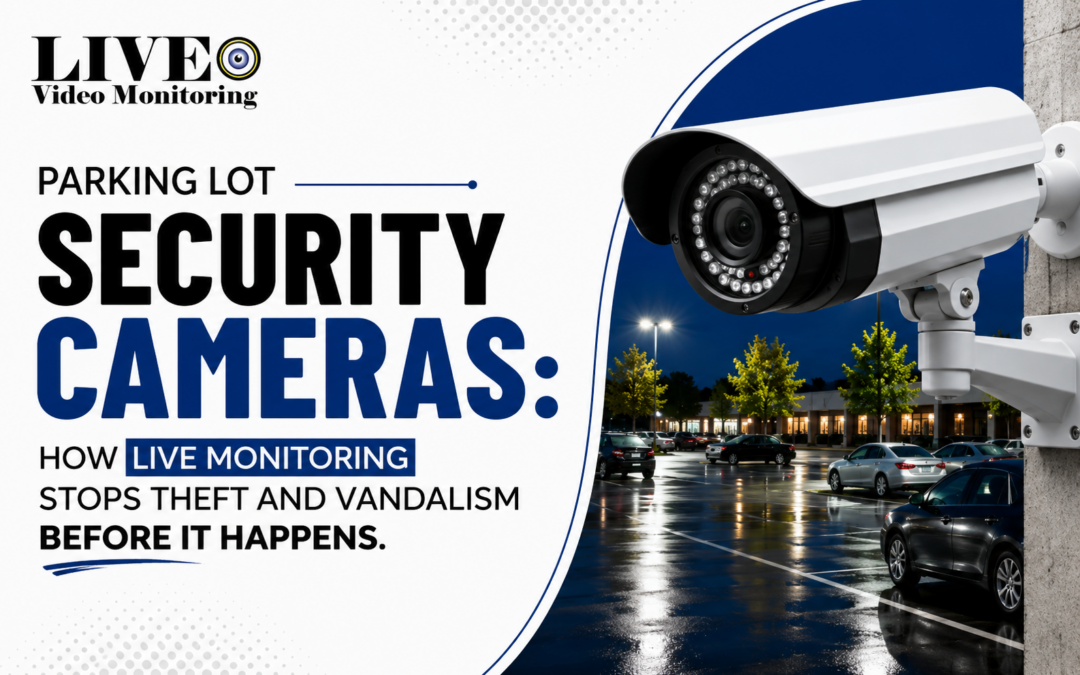
Parking lots are an easy target. Nearly 24% of vehicle thefts happen in parking lots or garages. About 12% of all theft cases happen there too. Crime in parking lots costs more than $6 billion a year across North America.
For property managers and plaza owners, that’s not just a number. It’s a risk sitting right outside the door.
Parking lot security cameras are the first step. But cameras alone don’t always stop crime. Recording a crime doesn’t stop it from happening. Live-monitored parking lot security cameras change that.
What are parking lot security cameras? They are cameras that watch parking areas. They spot odd activity, scare off crime, and save video as proof. Add live monitoring, and trained staff can act fast. They can stop theft or damage before it’s done, not just catch it on tape.
This guide covers why parking lots draw crime, how live monitoring works, which cameras work best, and how to build a full security plan.
Why Parking Lots Are Common Targets for Crime
Parking lots share a few traits. They’re big. They’re often dark. And no one watches them all the time. That mix makes them an easy target.
A few things make parking lots weak spots:
- Poor lighting near the edges and between rows
- Wide open space with many ways in and out
- Blind spots behind posts, ramps, plants, or parked cars
- Overnight parking with little to no watch
- Few staff on-site after hours
These gaps give thieves a real chance. Car theft, catalytic converter theft, and even attacks happen more in lots no one watches. Store theft has also grown in recent years. Thieves often run straight into the parking lot to get away. Without video proof, each of these can turn into a costly claim.
Signs You Need Parking Lot Security Cameras
Not sure if your lot needs an upgrade? Watch for these signs:
- Frequent break-ins or attempts
- Poor or patchy lighting
- Large areas used for overnight parking
- More safety complaints from tenants or shoppers
- A pattern of claims tied to the lot
- Little or no staff after hours
- Recent crime at nearby sites
If two or more sound familiar, it’s time for a risk check.
Why Traditional CCTV Isn’t Enough
Basic CCTV does one job well. It records. If a crime happens, that footage can help find a suspect or back up a claim.
But basic CCTV has one big flaw. It only reacts. It can’t stop a crime as it happens.
A camera that just records still lets the break-in happen. It gives you proof after the fact. And someone has to check the tape later, often hours or days after. By then, the car is gone. The damage is done. So is the thief.
This is why more sites now use live-monitored parking lot security cameras instead of plain CCTV.
| Traditional CCTV | Live Monitoring |
|---|---|
| Records the crime | Helps stop the crime |
| Gives proof after the fact | Allows quick action |
| No one watches live | Staff on duty, day and night |
| Reacts too late | Acts in time |
How Live Monitoring Works
Live monitoring is a security service. Trained staff watch camera feeds live. They check odd activity and act before it turns into a real problem. Someone is already watching when trouble starts.
Here’s how it works, step by step:
- A system spots odd activity. This could be a car parked too long, someone testing door handles, or motion in a closed area at night.
- An alert goes to the watch team right away.
- A live agent checks the video. This step is called a video check. It tells real threats apart from false alarms.
- A voice warning plays over on-site speakers. It lets the person know they’re being watched.
- Police or guards get sent if the person stays or the risk grows.
This whole chain can take just seconds, not hours. Studies back this up. Security Magazine reports that cameras alone can cut crime by up to 51%. A Cornell study found cameras rank as one of the best crime-stoppers around. And when cameras team up with watch staff and foot patrols, the Urban Institute found crime fell by 53%.
At Live Eye Monitoring, this is the whole point of the service: stop crime, don’t just film it. It’s also why false alarms drop fast once a live agent checks first. You pay for real action, not wasted trips.
Can security cameras stop theft? On their own, cameras mostly scare off thieves. Over half of burglars say they skip homes or lots with cameras in view. But live monitoring goes a step further. A real person can spot a threat and step in before the theft happens, not just catch it after.
Types of Parking Lot Security Cameras
Not every lot needs the same setup. The right mix of parking lot security cameras depends on your site’s size, light, and layout.
| Camera Type | Best For |
|---|---|
| PTZ Cameras | Large lots that need wide, moving coverage |
| Fixed Cameras | Entrances and exits |
| Fisheye Cameras | 360° views of open lots |
| Infrared Cameras | Night watch in low light |
| LPR Cameras | Reading plates and flagging cars on a watch list |
| Mobile Solar Towers | Short-term sites, work zones, busy seasons |
| AI Cameras | Spotting odd behaviour and cutting false alarms |
PTZ cameras pan, tilt, and zoom. They scan large lots from one spot. Fixed cameras stay still, aimed at one point. They work well at entrances, where people and cars pass through. Fisheye cameras give a wide, round view. You need fewer of them to cover an open lot.
Infrared cameras use night vision. They catch clear video even in low light. License plate cameras (LPR) read plates the moment a car passes. They flag stolen or watch-listed cars as they enter or leave. Mobile solar towers run on solar power and a cell signal. No wires are needed. That makes them a smart pick for New Brunswick sites with changing seasons, work zones, or extra parking needs.
AI cameras study motion and behaviour. They flag loitering or one car following another too close. They also filter out false alarms caused by wind, animals, or storms.
Are AI cameras better than standard CCTV? AI cameras don’t replace basic CCTV. They make it better. AI cuts false alarms and flags real threats faster. That means live staff can act sooner, with less guesswork.
Beyond Cameras: Building a Full Parking Lot Security Plan
Cameras are just one part of a strong plan. Experts often suggest pairing cameras with good light, access rules, and live monitoring. Cameras alone leave gaps. This layered plan has a name: Crime Prevention Through Environmental Design, or CPTED. It shapes a space so crime becomes hard to commit in the first place.
A few more steps worth adding:
- Lighting. Bright, even light removes the dark spots thieves rely on.
- Signs. A sign that says a site is watched acts as its own warning.
- Call stations. These give people a fast way to call for help.
- Access rules. Gates, key cards, or barriers limit who can enter.
- Barriers. Posts, fences, and curbs can stop a car from ramming through.
- Patrols. Foot or car patrols add a real human presence.
- Risk checks. An expert visit finds weak spots before someone else does.
None of this has to cost a lot or be hard to add. Even one new light or sign can cut risk. Paired with parking lot security cameras and live monitoring, small fixes add up fast.
Who Needs Parking Lot Security Cameras?
Parking lot security cameras aren’t just for big stores. Any site with shared parking can gain from them, such as:
- Shopping plazas and malls
- Apartment and condo buildings
- Hospitals and clinics
- Schools and colleges
- Warehouses and shipping hubs
- Hotels and motels
- Office parks
- City-run lots and garages
- Factories and plants
Each site faces its own set of risks. These range from staff safety to car theft to legal risk. That’s why a plan built for your site works better than a generic one.
Benefits of Live Parking Lot Surveillance
When cameras team up with live monitoring, the gains go well beyond catching a crime on tape:
- Stops theft before it’s done
- Halts damage in progress
- Protects staff and shoppers, most of all after dark
- Cuts legal risk with time-stamped video
- Speeds up and eases claims
- Scares off trespassers before they cause harm
- Cuts false alarms through real human checks
- Gives owners and tenants real peace of mind
LVT, a firm that runs mobile camera units, shares strong results from live-watched sites: a 70% drop in parking lot events, a 75% cut in violence, and a 43% drop in trespassing.
This doesn’t mean crime goes away for good. No system can promise that. But active watch cuts down how often crime hits and how bad it gets.
Choosing the Right Parking Lot Security System
Every site is different. The right parking lot security cameras setup rests on a few key points:
- Lot size – big lots need PTZ or fisheye coverage plus fixed cameras at each entry point
- Light levels – dark spots need infrared cameras or added light
- Hours of use – 24/7 sites need round-the-clock watch, not just daytime coverage
- Entry and exit points – these should always have their own camera
- Weather – New Brunswick’s snow, fog, and storms can hurt clear view, so tough, night-ready gear matters
- Camera spots – coverage should remove blind spots near posts, cars, or plants
- Live watch support – the system should allow real-time watch from a remote team
- Room to grow – the system should grow as your site or parking needs grow
How much does parking lot monitoring cost? Price depends on your lot’s size, how many cameras you need, and if you pick fixed units or mobile towers. Live Eye Monitoring offers a free visit to build a fair quote based on your site’s own risk.
Are security cameras worth it? For most sites, yes. A camera system almost always costs less than one bad theft, one act of damage, or one legal claim. That’s even more true when live watch is part of the deal, since it stops loss instead of just filming it.
A short visit is the fastest way to learn how many cameras you need and where to place them. For a setup built just for lots, see our car parking surveillance page.
Why Businesses Choose Live Eye Monitoring
Live Eye Monitoring runs 24/7 live video watch for parking lots, plazas, warehouses, and city-run lots across Canada. Instead of checking tape after the fact, trained staff watch your site live from a remote watch centre. They step in the moment something looks off.
Here’s what that looks like:
- 24/7 live watch by trained staff
- Custom plans built around your site’s layout and risks
- Fast action, from voice warnings to guard dispatch
- Deep know-how in retail, factory, and city parking
- Setups built to fit, from fixed cameras to mobile towers
- A Canada-based team with local, on-the-ground know-how
Every plan starts with a visit. Next comes a custom plan, a contract, and setup. If false alarms already hurt your site, read our guide on CCTV monitoring systems and how they stop false alarms.
Conclusion
Parking lot security isn’t just about how many cameras you own. It’s about who is watching, and how fast they can act. Basic CCTV gives you proof after harm is done. Live-monitored parking lot security cameras give you a real shot at stopping it first.
If theft, damage, or late-night risk worries you, it’s worth a quick chat about what live watch could do for your lot.
Worried about theft, damage, or late-night risk in your parking lot? Live Eye Monitoring runs 24/7 live video watch with trained staff who can spot odd behaviour, check threats, and act in real time. Request a free parking lot security check today to talk through a plan built for your site.
📍 304 Hughes St, Noonan, NB 📞 1-855-744-6466 ✉️ info@liveeyemonitoring.com
Frequently Asked Questions

Daniel McAllister is a Canadian security specialist with extensive experience in CCTV surveillance, remote video monitoring, and property protection systems. As part of the Live Eye Video Monitoring team, he focuses on proactive threat detection, real-time incident response, and helping businesses across Canada improve their security infrastructure. His insights are based on hands-on experience with live monitoring operations and evolving security technologies.