
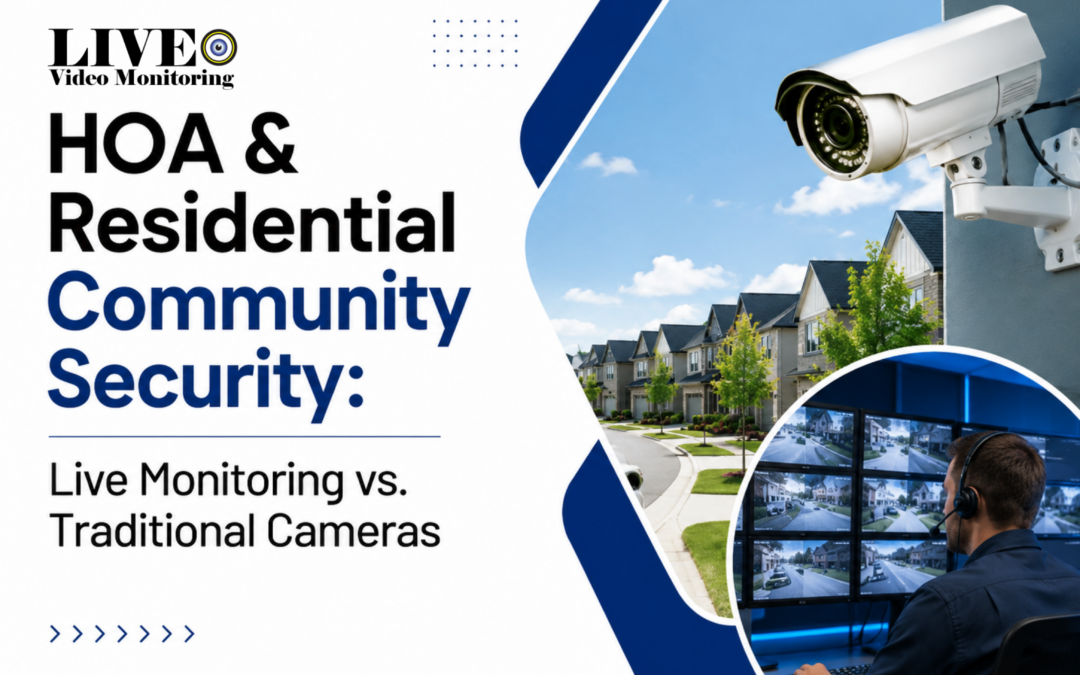
Live monitoring is different from traditional CCTV because trained operators verify suspicious activity in real time and can respond immediately, while standard CCTV only records footage for someone to review later. That single distinction shapes almost everything a board needs to know about protecting a residential community.
Vehicle break-ins in the parking lot. A package stolen from a porch. A stranger walking through the clubhouse after hours. For HOA boards, condo corporations, and strata councils across Canada, these are everyday concerns — not rare events. People living in condos and apartment-style buildings are disproportionately affected by delivery theft compared to single-family homes, and national data shows shoplifting and property crime trends have climbed in recent years, which adds pressure on shared community spaces too.
Most communities respond by installing HOA security cameras. It’s a reasonable first step. But many boards later ask the same question: are traditional cameras actually stopping anything, or just recording it?
That’s the real difference between traditional CCTV and professionally monitored live video surveillance — and it’s the question this guide answers, with practical guidance for boards in Fredericton, across New Brunswick, and throughout Canada.
Understanding HOA Security Cameras
HOA security cameras are surveillance systems installed in shared community spaces to record activity, deter wrongdoing, and provide evidence after incidents. On their own, they don’t stop something from happening — they only capture it.
Communities typically place cameras at:
- Main entrances and gates
- Parking lots and garages
- Clubhouses and shared amenities
- Walking paths and common areas
- Mailrooms and package delivery zones
These systems have real value as part of a layered community security system. A visible camera can discourage casual wrongdoing, and recorded footage helps investigators piece together what happened. But a camera cannot see a problem developing and choose to act. It simply records, and someone has to review the footage later — often after the damage is already done.
What Are HOA Boards Responsible For?
HOA boards are generally expected to provide “reasonable” security in common areas — not guaranteed safety. This includes risk assessment, resident communication, incident documentation, and maintaining basic infrastructure like lighting and locks.
In practice, this means boards should:
- Regularly assess risks across the property
- Keep shared spaces reasonably secure (lighting, gates, locks)
- Communicate clearly with residents about what security measures are in place
- Document incidents consistently for insurance and legal purposes
It’s important boards avoid promising more than they can deliver. Cameras and monitoring may help reduce risk, but no system can guarantee that incidents won’t occur. Communities that overstate their security capabilities can create unrealistic expectations — and unnecessary liability exposure.
A Simple Risk Assessment Process for HOA Boards
Before buying equipment, most security professionals — including organizations like ASIS International — recommend boards start with a structured risk assessment rather than jumping straight to hardware:
- Review incident history. Pull the last 12–24 months of reported incidents, complaints, and maintenance logs.
- Walk the property. Identify blind spots, poor lighting, unsecured entrances, and areas with limited visibility.
- Survey residents. Ask what concerns them most — vandalism, package theft, unauthorized visitors, parking issues.
- Rank the risks. Prioritize by likelihood and potential impact, not just visibility.
- Match the solution to the risk. A small townhome HOA with occasional vandalism may need different coverage than a large gated community with 24-hour vehicle traffic.
This process prevents overspending on cameras that don’t actually address a community’s biggest risks — a common mistake boards make when security purchases are reactive rather than planned.
Traditional CCTV Systems: Benefits and Limitations
Traditional CCTV deters some casual wrongdoing and provides recorded evidence, but it is reactive by design — footage is reviewed after an incident, with no one watching or responding in real time.
Benefits
- Visible deterrence — cameras and signage discourage some opportunistic behaviour
- Recorded evidence — footage supports investigations after an incident
- Insurance support — documented footage can assist with claims
- Investigation assistance — police and property managers can review recordings
Limitations
- Reactive only — footage is reviewed after the fact, not during the event
- No intervention — no one is watching in real time to stop what’s happening
- Delayed response — by the time footage is reviewed, the person is often gone
- False sense of security — residents may assume cameras mean “someone is watching,” when no one actually is
- Missed opportunities — early warning signs go unnoticed without active review
A Realistic Scenario
Consider a mid-sized condo complex with traditional CCTV only. At 2:15 a.m., someone walks through the parking garage, checking vehicle door handles. The cameras record the entire event in high definition. Nobody is watching. By the time a resident notices a scratched vehicle the next morning and management pulls the footage, the individual is long gone, and there’s little the board can do beyond filing a police report and an insurance claim.
This is why more Canadian communities are pairing cameras with residential community surveillance that includes real-time human oversight.
How Live Monitoring Changes Community Security
Live monitoring combines AI-powered detection with trained human operators who watch activity in real time, verify what’s happening, and respond immediately — through audio warnings or dispatch — before an incident escalates.
Using the same parking garage scenario: with live monitoring in place, AI analytics flag the 2:15 a.m. movement as unusual within seconds. A trained operator at a remote monitoring centre reviews the live feed, confirms it’s not a resident or delivery driver, and issues a recorded audio warning through the camera speaker — announcing that the area is under active surveillance and monitored by security personnel. In many cases, that alone is enough to make the individual leave before any damage occurs. If the person doesn’t leave, the operator can escalate and contact police or on-site security with real-time details, including direction of travel and a description.
The process generally works like this:
- AI analytics scan live video feeds continuously, filtering out harmless movement like blowing leaves or passing cars
- Detection — the system flags unusual activity, such as someone loitering near a gate late at night
- Human verification — a trained operator at a remote monitoring centre reviews the flagged footage
- Immediate response — if the activity looks suspicious, the operator can act right away
- Audio warning — a live voice-down can be issued directly through the camera speaker
- Police or security dispatch — if needed, the operator contacts authorities or on-site security with real-time details
How AI Analytics Actually Work
AI-powered neighbourhood security cameras use video analytics software to distinguish between routine movement (trees, shadows, animals, vehicles passing on a nearby road) and activity worth flagging (a person loitering, a vehicle stopped in an unusual spot, someone testing door handles). This filtering is what keeps a monitoring centre from being overwhelmed with irrelevant alerts. Industry data on video-verified alarm systems suggests well-configured AI filtering can cut false alarms significantly compared to traditional motion-sensor systems, which helps operators focus attention on genuine incidents rather than reacting to every gust of wind or passing raccoon.
This combination of AI-powered detection and human judgment is what separates monitored CCTV from a camera that simply records and waits.
Live Monitoring vs Traditional Cameras
| Factor | Traditional CCTV | Live Monitoring |
|---|---|---|
| Detection | Manual review after the fact | Real-time AI detection |
| Response | None — footage only | Immediate human response |
| Evidence | Recorded footage | Recorded footage + verified incident logs |
| Crime Prevention | Limited deterrence | Active deterrence with intervention |
| False Alarms | N/A (no monitoring) | Reduced through human + AI verification |
| Operating Hours | Passive, 24/7 recording | Active, 24/7 monitored |
| Human Verification | None | Yes, trained operators |
| Liability Support | Evidence after incidents | Evidence plus documented response actions |
| Scalability | Limited by storage/review capacity | Scales across multiple sites and cameras |
Decision Matrix: Matching Security to Community Type
| Community Type | Recommended Security Approach |
|---|---|
| Small HOA (low incident history) | Traditional CCTV + alarms |
| Mid-sized condo complex | Live monitoring |
| Gated community | Live monitoring + access control |
| Large or luxury community | Live monitoring + license plate recognition + access control |
Choose Traditional CCTV If:
- Your budget is very limited
- Evidence collection after an incident is your primary goal
- The property has low foot traffic and a low incident history
- You already have on-site staff or security who can review footage regularly
Choose Live Monitoring If:
- You want proactive intervention, not just documentation
- Package theft, trespassing, or vandalism are recurring issues
- Liability and board accountability are ongoing concerns
- The property operates 24/7 with vehicle and pedestrian traffic at all hours
- On-site guards aren’t practical or affordable for your community’s size
What Does It Cost: Guards vs. Live Monitoring
On-site security guards typically cost more per hour than a monitored camera system covering the same area, because one live monitoring setup can oversee multiple entrances, parking areas, and common spaces simultaneously instead of requiring a guard physically present at each location.
Exact pricing depends on property size, number of cameras, and coverage hours, so boards should request a custom quote rather than relying on general estimates. That said, the general pattern most Canadian communities find is straightforward: a single on-site guard can only watch one area at a time and needs to be paid around the clock for full coverage, while a live-monitored camera system can extend coverage across an entire property at once, with operators split across multiple sites. For many mid-sized condo and gated communities, this makes monitored surveillance a more budget-efficient way to achieve 24/7 coverage than staffing guards for the same hours.
HOA Budgeting Considerations
When boards build security into the annual or reserve fund budget, it helps to weigh:
- Upfront equipment and installation costs vs. ongoing monitoring fees
- Whether monitoring costs replace or supplement existing guard contracts
- Potential savings from reduced vandalism, theft, and related repair costs
- How the investment supports documentation for insurance and liability purposes
- Multi-year contract terms and scalability as the community grows
Why Canadian Communities Are Moving Toward Live Monitoring
Canadian communities face long winter nights, large multi-building properties, and rising resident expectations — all conditions where 24/7 monitored surveillance is often more practical and cost-effective than round-the-clock on-site guards.
Canadian residential communities face conditions that make live monitoring especially useful. Long, dark winter evenings in Fredericton and across Atlantic Canada reduce visibility and can affect camera image quality, particularly with standard low-light lenses — a challenge that’s less pressing in regions with shorter winters. Snow, ice, and reduced foot traffic during colder months can also make some areas of a property feel more isolated, which is exactly when active monitoring adds the most value.
Larger developments, including multi-building condo complexes, are harder to patrol manually. Boards are also facing rising resident expectations around safety, more affordable AI-powered technology, and pressure to keep operating costs manageable, all of which point toward HOA video monitoring Canada solutions rather than camera-only setups.
Managing Privacy and Liability
Boards can support resident privacy by placing cameras only in common areas, posting clear signage, limiting footage access, and setting a defined retention policy — while avoiding legal claims about guaranteed safety.
Cameras in shared spaces raise legitimate privacy questions, and boards should approach this thoughtfully. General good practices include:
- Placing cameras only in common areas, never in private spaces
- Posting clear signage where surveillance is active
- Setting a defined footage retention period
- Limiting footage access to authorized personnel
- Being transparent with residents about how surveillance is used
This is general guidance, not legal advice. Boards should consult qualified legal counsel and reference resources like the Office of the Privacy Commissioner of Canada when developing formal camera and privacy policies. For criminal matters, coordination with local police or the RCMP is typically handled through the monitoring provider or property management, not the board directly.
Practical Security Checklist for HOA Boards
✔ Review recent incidents and identify patterns
✔ Walk the property to spot vulnerable areas
✔ Improve lighting in low-visibility zones
✔ Secure entrances and shared access points
✔ Install cameras in key common areas
✔ Consider access control for gates and buildings
✔ Evaluate whether live monitoring fits your community’s risk level
✔ Train property management staff on security protocols and incident reporting workflow
✔ Conduct a periodic security audit and review the plan annually
Why Live Eye Monitoring Is Different
Live Eye Monitoring is a Canadian company offering tailored HOA video monitoring solutions for residential communities across the country. Rather than a one-size-fits-all setup, monitoring plans are built around each property’s layout and risk factors, following a straightforward process: consultation, custom surveillance planning, deployment, and active 24/7 monitoring.
AI-powered video analytics work alongside trained operators who monitor camera feeds 24/7, allowing suspicious activity to be verified and responded to in real time rather than discovered the following day. When required, the service includes live audio warnings, coordinated dispatch, and detailed evidence documentation to support strata boards after an incident.
Beyond residential communities, the same monitoring approach supports commercial security monitoring, construction site monitoring, and parking lot monitoring — useful context for property managers overseeing mixed-use developments or nearby commercial assets. To see how the underlying technology works in more detail, read How Remote Video Monitoring Works and explore Community Surveillance Solutions built specifically for residential communities, or learn more about AI video analytics for perimeter security and visitor management.
Conclusion
Traditional CCTV records what happened. Live monitoring helps prevent it from happening in the first place. For HOA boards, condo corporations, and property managers across Canada, that distinction matters — especially as communities grow larger and expectations around safety continue to rise.
The right approach isn’t necessarily choosing one over the other. It’s understanding where traditional cameras fall short, and deciding whether professionally monitored HOA security cameras make sense for your community’s risk profile, whether that’s a small gated community CCTV setup or a full condo complex security monitoring program.
Not every residential community needs the same security setup. A professional security assessment can identify vulnerable areas, review existing CCTV coverage, and determine whether live monitoring could improve response times and reduce risk. Contact Live Eye Monitoring, based in Fredericton, New Brunswick, to discuss a solution tailored to your community.
Frequently Asked Questions
Find answers to the most common questions about HOA security cameras, live monitoring, privacy, costs, and security policies.
Do HOAs need board approval to install security cameras?
How does community surveillance protect resident privacy?
Who can access footage from an HOA’s security cameras?
Can live monitoring reduce HOA insurance and liability costs?
What’s the difference between recorded CCTV and live-monitored cameras for a community?
How much do HOA security cameras cost?
Can HOA cameras record audio?
How long should security footage be retained?
Are AI-powered security cameras worth it for HOAs?
How often should HOA security policies be reviewed?

Daniel McAllister is a Canadian security specialist with extensive experience in CCTV surveillance, remote video monitoring, and property protection systems. As part of the Live Eye Video Monitoring team, he focuses on proactive threat detection, real-time incident response, and helping businesses across Canada improve their security infrastructure. His insights are based on hands-on experience with live monitoring operations and evolving security technologies.